Enter Art Fair, Copenhagen
27, 28, 29, 30 September 2026
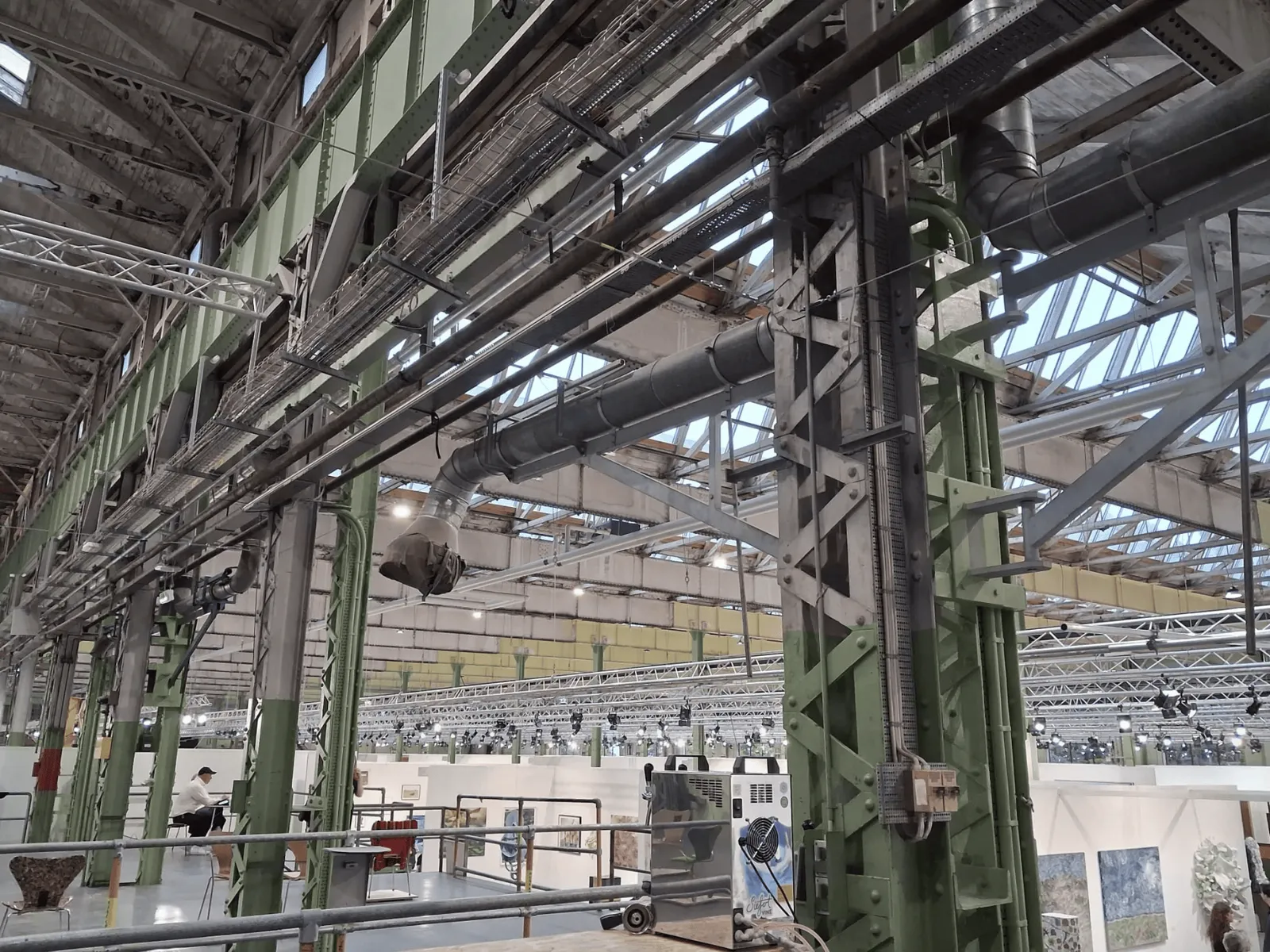
This is the only picture I took at the Art Fair. It was housed in the Lokomotivværkstedet (Locomotive Workshop), which for me was the most interesting aspect of the Fair.
“My Stunning Mystery Companion” (Jackson Browne) had two VIP tickets to the Enter Art Fair in Copenhagen, so we went on a little 24-hour adventure trip to Denmark and back by bus. The Flixbus left Hamburg at 01:00 on Sunday and got to Copenhagen at 05:30. It was a gray day, intermittent rain, not cold, around 20°, but humid. Some of the locals were in t-shirts, some in shorts. The rain was not hard, at least not most of the time, the kind of drizzle that only soaks in if you are planning to be out in it for a while.
My stunning companion insisted that I take a jacket that looked good. I wanted to take one that repelled the rain. She won, and eventually my good-looking jacket got soaked. Why? Because in Denmark, although you can pay for everything with a credit card, they have their own currency still, the Danish krone, DKK, and they don’t take euros anywhere. Problem is, if you want to ride on public transportation, you need the right app on your phone, or you need DKK in your pocket. No credit card payment on the bus. The transport app wouldn’t load on my phone, wouldn’t load on hers, and no DKK in any pockets. So we had to walk through the, I said “intermittent” but sometimes continuous rain for long enough so it could soak through that better-looking jacket while her rain jacket worked just fine. — OK, finished with complaints now.
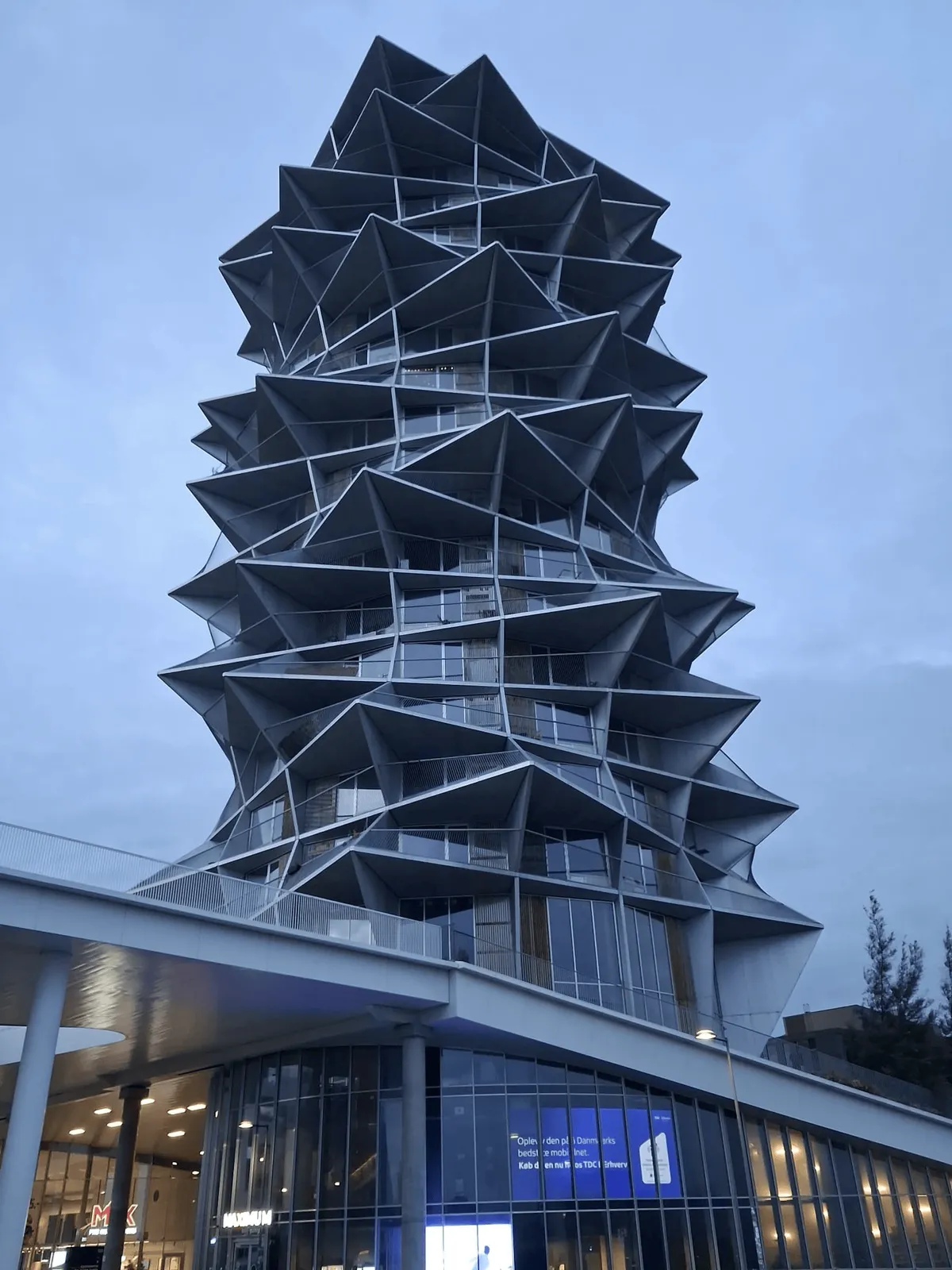
First thing we did is walk from the bus station near the local IKEA and this amazing apartment block
to a huge trash burning plant, Amager Bakke, also known as Copenhill, which is a combined heat and power waste-to-energy plant that has a dry ski run that looks like AstroTurf grass circles held down by wire mesh. It also has a hiking trail and climbing wall, so people actually leg it up to the top. Here’s more info: https://en.wikipedia.org/wiki/Amager_Bakke.
Anyway, we walked for 90 minutes to get there, mostly because my companion insisted that it would be fun. And it was to a certain extent. At least I hadn’t yet gotten completely soaked.
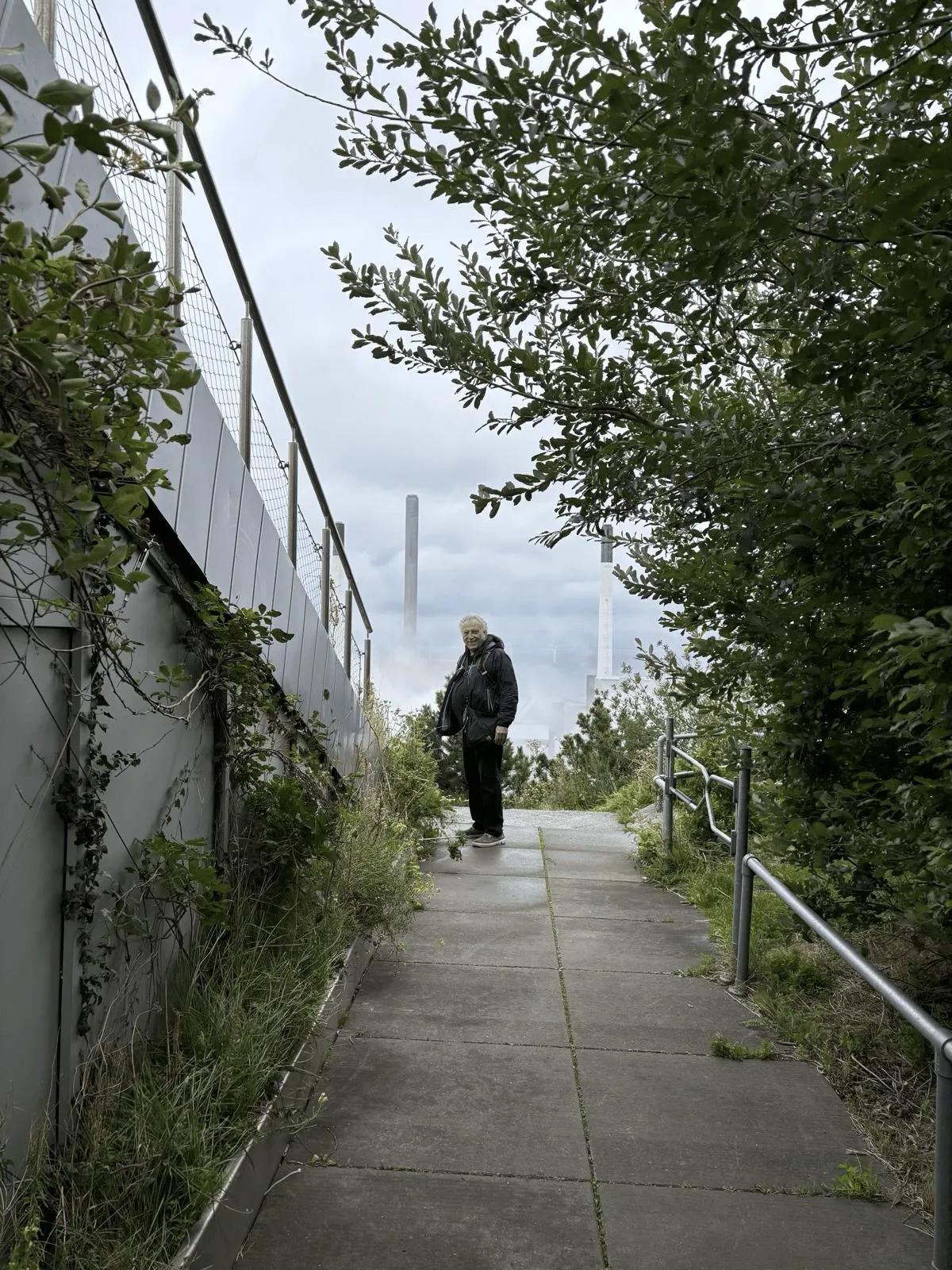
So there we were, at the top, with an amazing view of Copenhagen and the waterways that crack the city into pieces, above us the tall chimney that spewed water vapor, not smoke. At the nice cafe near the entrance of the place, down below, I drank an Americano and ate half a toasted sandwich. We got back on the road. This is when we had our “can’t pay for the bus ride” experience.
The walk from there to the Art Fair took only an hour and 15 minutes. The difference being that by this time, with more frequent periods of rather heavy rain, my jacket got progressively more soaking wet. A tiny umbrella helped a little, until I forgot the compressed and rolled up umbrella at a covered rest stop along the way.
We eventually got to the Enter Art Fair. Once inside, my companion got us our pretty pink cloth VIP bracelets and we put our jackets and rucksacks in the garderobe. 90 DKK, paid by credit card.
I took a breather and dried out a bit, now in my black t-shirt that was unfortunately also wet, mostly from sweat after being covered by that stifling jacket. My black hoody was draped on the back of the chair so it could dry as well.
In this raised area, where the interviews and film presentations were to take place, there were about 50 or 60 chairs set out, all different, but comfortable wooden designer chairs of various colors. Only about 20 of these chairs were occupied however. An artist was on stage with an interviewer and he was talking about how music and sound influenced his art. At least that was what it said in Danish (close enough to German and English so I could read what was on the large screen behind him). He was speaking a language I couldn’t understand, and the lady interviewing him translated his language into Danish—which I also can’t understand. So I was able to relax. Actually, I was hoping they would play some of the music or sounds that inspired him, but all they did was talk.
A group of five ladies, well into that middle age where they are not yet old enough to get that cozy grandma look, but still young enough to think they can pull off looking 10 years younger than they really are—so, about 50, or approaching it fast. They had come to listen to the artist, I suppose, and sat on chairs not that far away from me. They were all expensively and tastefully dressed and groomed. One had stark almost white blond hair (like Dolly’s, but let loose) that cascaded in thick strands down over her shoulders, over a slick shiny long-sleeved blouse top with the kind of patterns preferred by Italian and French designers. She also wore knee-length dark brown leather boots. The ladies talked sotto voce amicably and excitedly so that they wouldn’t disturb the interview. But it seemed to me they were more interested in themselves than the artist.
After doing what she had to do, my companion signaled to me from below that she was ready, so I went down to meet her. She suggested we walk around the rather large warehouse separately, but I said I’d like to start walking with her. Which we did for about two paintings, until I said: “That looks like a painting of a guy sitting on a toilet.” Then she suggested that we meet in an hour near the entrance and we went our separate ways. I wondered for a moment whether it was my comment or the fact that my t-shirt hadn’t dried yet and I looked a bit shabby under my still humid black hoody. It was probably both.
As you have probably guessed by now, I’m not an art critic. I’m not even a connoisseur of good art (or bad art). I appreciate the fact that there are people with incredible skills who put pencil or pen or brush to paper or canvas or whatever medium they use. My taste is derived from the fact that my mother always had two Gauguin paintings hanging on the wall of whatever apartment we were living in at that time: The Prince and Arearea. I grew up with them. I still have them on my walls. (Obviously not originals!) They are old full-size prints she got from Germany while she was stationed in Zagreb.
I like certain classical paintings, mostly the Raphael-type school of painters, really ancient Greek and Roman stuff, some impressionist paintings that I saw in Zurich at the Bührle (https://buehrle.ch/) house, which is also a museum.
[Aside: I went to Zurich in November 2007 with an American woman who at that time was my stunning companion. She was of Sicilian heritage, originally from Buffalo, and after our tour in that large house—not really a mansion—that had only minimum security, a few months later, three masked men broke in, held people at gunpoint, and stole 4 paintings together worth about $160 million. She went back to Los Angeles and we stayed in touch. I used to call her on Skype. After the robbery, in February of 2008, on one of the Skype calls I joked with her about the heist, I said: “Who did you tell about the Bührle and how easy it was to rob?” This, she didn’t find amusing. In fact, she didn’t utter a word in reply. Our long distance affair petered out not long after that conversation. And of course I always wondered: Who did she tell? — The Serbian thieves were caught in 2012.]
And then again, I get a kick out of anything Dada because, well, because it’s Dada and you have to love their brashness and ingenuity and their obvious “fuck you” to the establishment and the established opinions that screw artists and destroy art.
So what has changed? The establishment is no longer a bunch of “I know better than you do” art critics and professors. Now it’s money, the arrogance of money, which has been injected into the veins of the business through a coalition of gallery owners and oligarchs looking for investment opportunities. They couldn’t give a fuck about the painting itself, or whether they actually like it or not, as long as it’s a good way to stave off their destitution after the certainty of the societal failure they are doing their best to instigate.
But Mondrian and the abstract painters and the squiggles that people slash or drip on canvas, I don’t like so much. Of course I recognize the skill needed to do that stuff, and the years of working through styles and self until you find that part of you that expresses itself in the painting. But, you know, it’s like, wow, you have finally expressed your inner you, but, well, you, who you are and how you express yourself just doesn’t interest me. After 3 minutes of talking with you at the party I want to move on, talk to somebody else, get another drink.
For instance—and I know some “art” people won’t like me for this—I don’t see any value in Andy Warhol’s work, the endless repetition, the banality of it all, nor in his amoral lifestyle and the really negative influence he had on so many talented young people. I can fully understand why some loony in his orbit tried to kill him.
But that’s just me. Lots of people don’t like me. They don’t like me for reasons unrelated to my job as a rhymer or a writer. Of course that doesn’t exclude the possibility that people don’t like my rhyme work or my writing.
That’s OK. I’m not purporting to be anyone important. I just do what I do. If you like it, thank you. If you like me, thank you. If you don’t, well, so what? Actually, so what? in both cases. All I do is so insignificant in the larger scheme of things. In the end, even Shakespeare, one of the skilled people I actually admire, is insignificant in the larger scheme of things. All this stuff that is out there now in our age, our era, is insignificant, just so much pleasure poison, mostly pleasure for the egocentric artist (like me with rhyme work) and poison for the rest of humanity.
Silently walking through the Art Fair, my indignation grew, the more I saw. Unable to deliver running commentary to any companion, I decided to speak it into my phone.
Here is a transcript of what I said (edited for clarity and sanity):
So what I want to do is make comments on some of the stuff that I see here, which I’m not really impressed with—that is, technically, everybody’s great. Everybody has great technique. It’s like the best musicians in the world are around today. Everybody plays the best piano, everybody plays the best guitar, everything you want. And here everybody can paint—do whatever it is—with great technique. But the subject matter is depressing.
It’s like nobody has anything good to say. It’s like everybody’s totally living in a world that’s broken. And guess what? It is broken. (Dylan: Everything is Broken) The way that things are shown, the way that people act, it’s really sad. And so I was thinking earlier, looking at all these pictures, the technique is excellent. Everybody has painting technique down to a fine art, as they say. But what are they saying? They’re not saying anything except, “I’m sad, I’m bored, the world is shit, and I wish I had more money.”
There’s really nothing. Nothing. So, anyway, my final comment on the whole thing is: Maybe really what we do need now is to have the political authoritarianism that’s coming in the United States, the fascism that is already ruling a lot of places. I think, after a total repression and destruction by these wretched political forces, that might cause some kind of effect, like, you know, putting everything into a pressure cooker, and then all this bullshit stuff will fall away, disappear, because nobody cares, nobody has money, nothing’s happening.
When there’s massive destruction, massive death, after that, people do something to break open and build something that is completely different. And the end of the whole thing is like the end of the First World War. After that, you have Dada and everything else exploding, none of this bullshit.
I’m really a bit disappointed because the colors are great, the technique is great. Everybody and everything is sponsored and it all costs money. I don’t want to say “I could do it.” I can’t. These are all people who have studied whatever they studied and they perfected their technique.
Like I said, all the musicians today are a thousand times better than they were a hundred years ago. There’s more of them and all of them are great. So, yeah, we’ll see. Tonight or tomorrow at some point I’ll have a poem about this. But I didn’t take any pictures because there’s no use. There’s people going around taking pictures all the time. And there’s no use taking a picture. What does it mean? These things are little pictures in themselves that mean nothing. Your phone is filled up with pictures. This is an exhibition that’s filled up with pictures. And it means just as little as it does when these pictures are on your phone.
There are a few things that are humorous. Like the piece with a bunch of green tennis balls piled up in a pyramid in a bowl, with a knife on the table in front of the bowl. A still life with greenish tennis balls. And on the table in front of the bowl, one of the tennis balls is cut as if the skin of an apple has been peeled. The skin shows us the ball is empty. It’s a humorous rendition of some painting that was there before—at least I remember seeing a peeled apple painting once upon a time. That one was probably also humorous in some way, I don’t know. [Bond of Union by Escher, 1956.]
Okay, I can get behind the humor. But everything else is totally depressing, meaningless. Nothing is beautiful. Faces are distorted, scribbles deface a canvas. They’re like bad dreams. It’s not something that I would ever put up on my wall. And [after we met randomly at a place in the exhibit] my companion said [pointing] “there are a few paintings that look like the faces you draw.” Yes, but mine are not art. These are by an artist. And so they have a certain style. They have all that. And the style repeats itself, you know, it’s quite distinct. That must be him. It must be her. The artist is recognizable. Something like that.
And then. Yeah, I’m sorry. It’s as if all the artists are really, really bored and have nothing else to say, nothing to do.
When I sat down on a comfortable couch in the middle of the New German Artists section and read SLEEK magazine, about all the different artists that they featured, it was like everybody’s into deep philosophical questions: Integrity. And what do you feel? And how do you deal with all these things in your life? And what inspired you? What do you want people to think when they look at your painting? And the artist has to answer these things, when actually the artist should be just saying one thing only. That is: “Yeah, look at it. Buy it if you like it, if you don’t, fuck off.”
Anyway, so. All right, take care.
I don’t know why I said: “Take care” but I guess it’s because I was treating it a bit like a phone call to somebody. That somebody was future me, and I was telling that future me to “take care.” Good advice, because that immediately future me had to eventually walk back to the bus station.
There was a garden outside the warehouse that you could get to through the side doors, with picnic tables covered by white canvas canopies. The food trucks offered sushi (which I never touch unless it’s served in a Japanese restaurant where Japanese customers eat), a burger truck (which really tempted me), and a truck with falafel salad and vinegar fries. I eventually went for the falafel and fries. It was more in keeping with the way I had changed my intake of food lately.
Fed, dry and rested, it was almost time to get back on the road and walk to the bus station—only 30 minutes away. We got our jackets (mine still pretty wet) and rucksacks from the garderobe and … downpour. People were clogged at the door watching the rain splash on the walkway and rattle on the roof of the awning over the entrance.
Twenty minutes later the sun was back, winking through the sparse cloud cover.
This time the walk was more fun because I didn’t need my jacket, the hoody was enough. Along the way I finally found a piece of art I liked and thought was meaningful and positive, so I took this final picture:
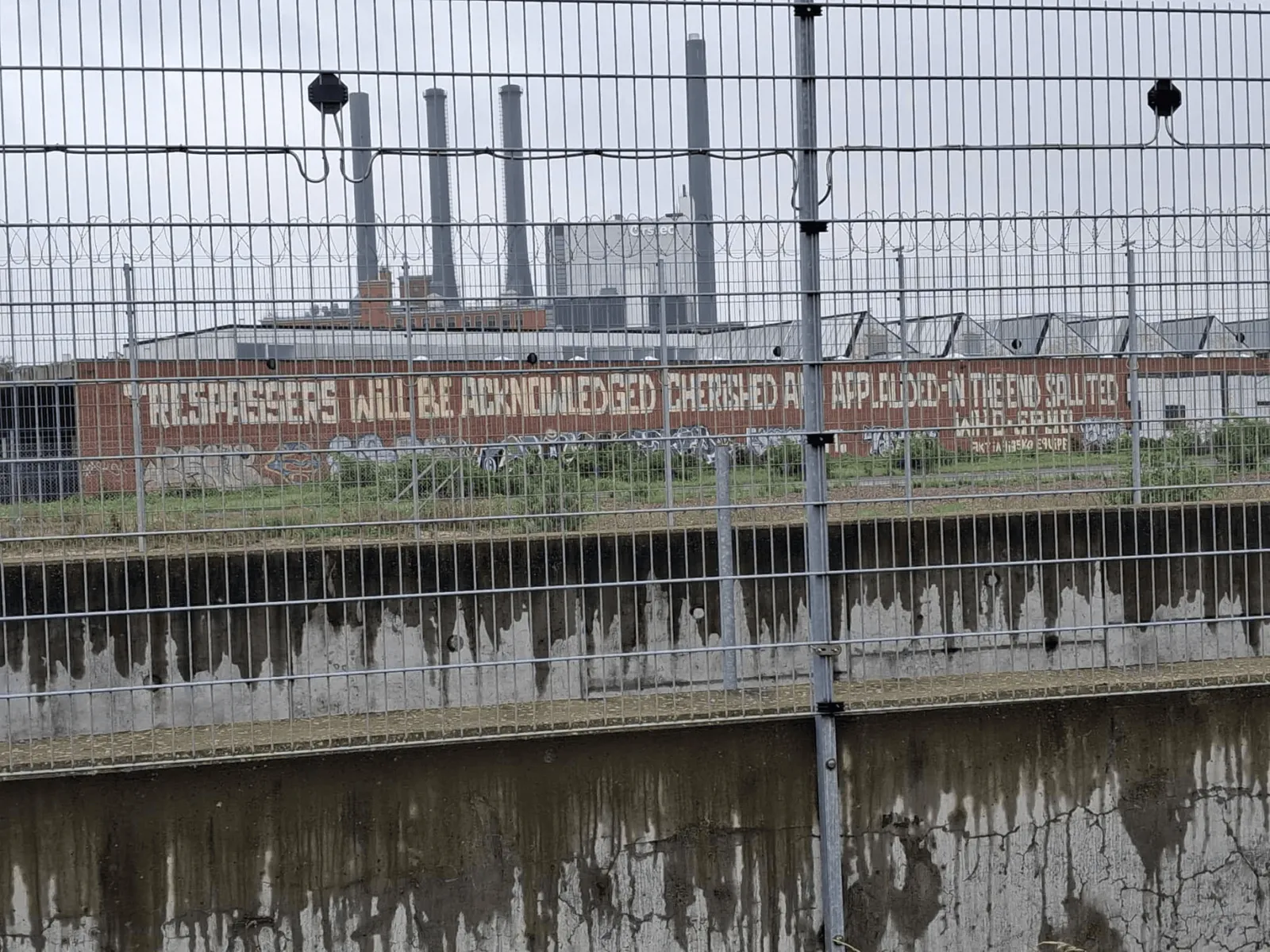
Trespassers will be acknowledged cherished and applauded-in the end saluted
At 18:35, our bus left for Hamburg.
As we crossed the Great Belt Bridge to the Danish mainland, this happened:
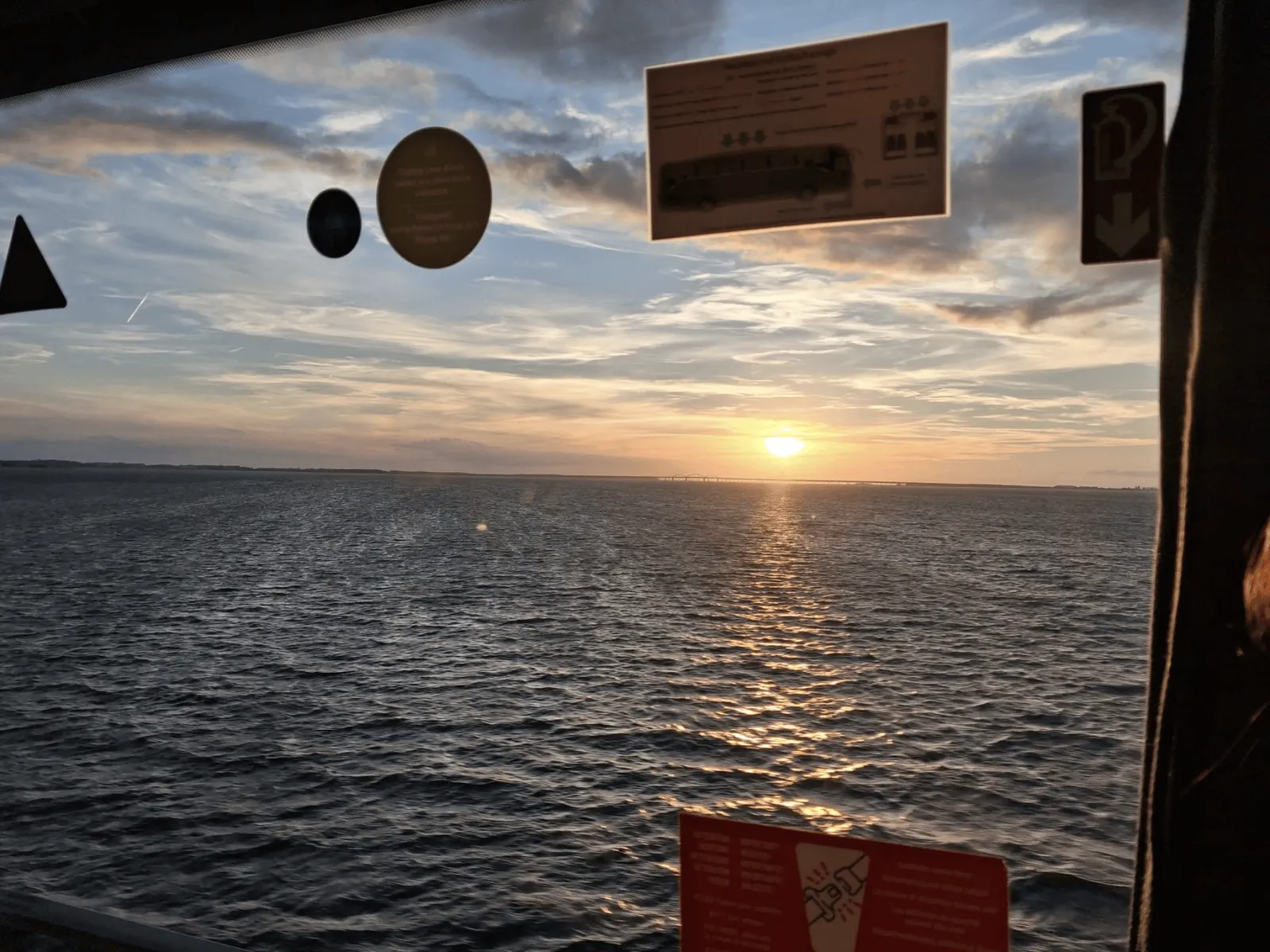
We arrived in Hamburg at 00:05 Monday morning. The 24-hour adventure with my stunning companion had come to an end.
Oh yeah, at the Fair I only talked to one person, a smiling Latino guy who was shilling for one of the exhibitors. He wore a t-shirt with ART WILL SAVE US on his back. I smiled at him and he approached me with a sheaf of infos in his hand. Before he could speak, I looked him in the eye and said: “No it won’t!”
He took a beat then silently laughed as I walked away.